Source:https://mp.weixin.qq.com/s/ZwVmuout1Yve31OUXOg5Hw
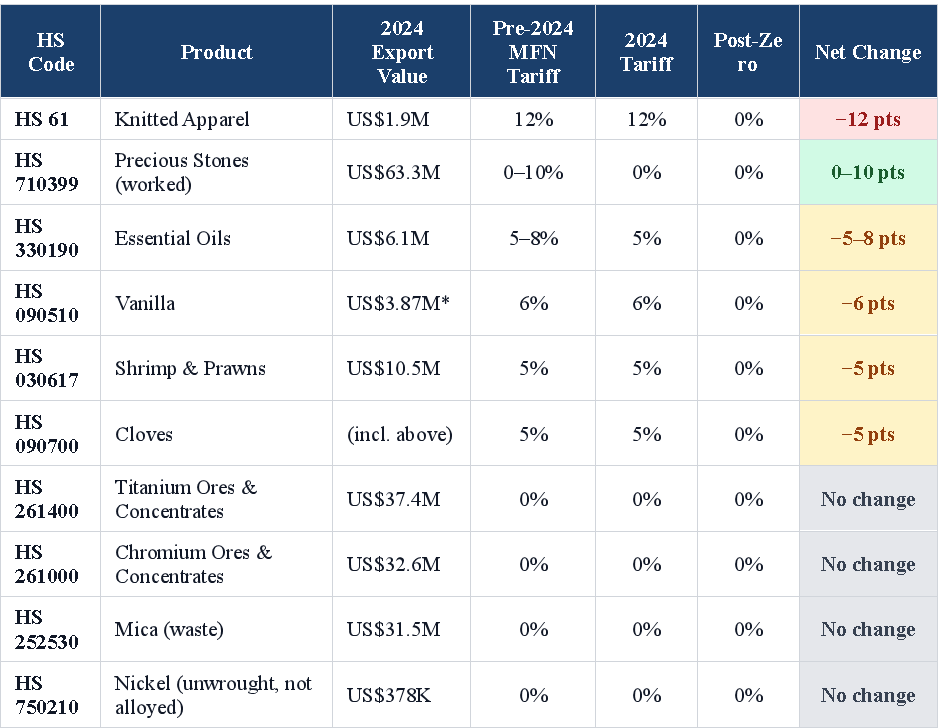
Madagascar — Tariff Schedule (LDN from 1 December 2024)
Total Exports to China (2024): US$265.85 – US$268.33 million
Impact: MODERATE
Madagascar's LDN designation provides full zero-tariff coverage as of December 2024. Its export mix is notably more diversified than most SADC peers—combining precious stones and ores (low/zero tariffs) with vanilla, cloves, shrimp, essential oils, and knitted apparel. The moderate impact reflects this duality: minerals gain little, but agricultural and textile exports benefit meaningfully. On the textile front, Madagascar has established garment manufacturing sectors serving major international retail brands. With apparel (HS 61) previously subject to a 12% MFN duty in China and footwear (HS 64) facing 10–24%, zero-tariff access now positions Madagascar as a potentially viable low-cost manufacturing base. Meanwhile, Madagascar's vanilla sector—where it holds over 80% of global supply — faces low Chinese tariffs historically but could benefit from protocol simplification under the LDN framework.
Namibia — Tariff Schedule
Total Exports to China (2024): US$1.12 – US$1.44 billion
Impact: LOW
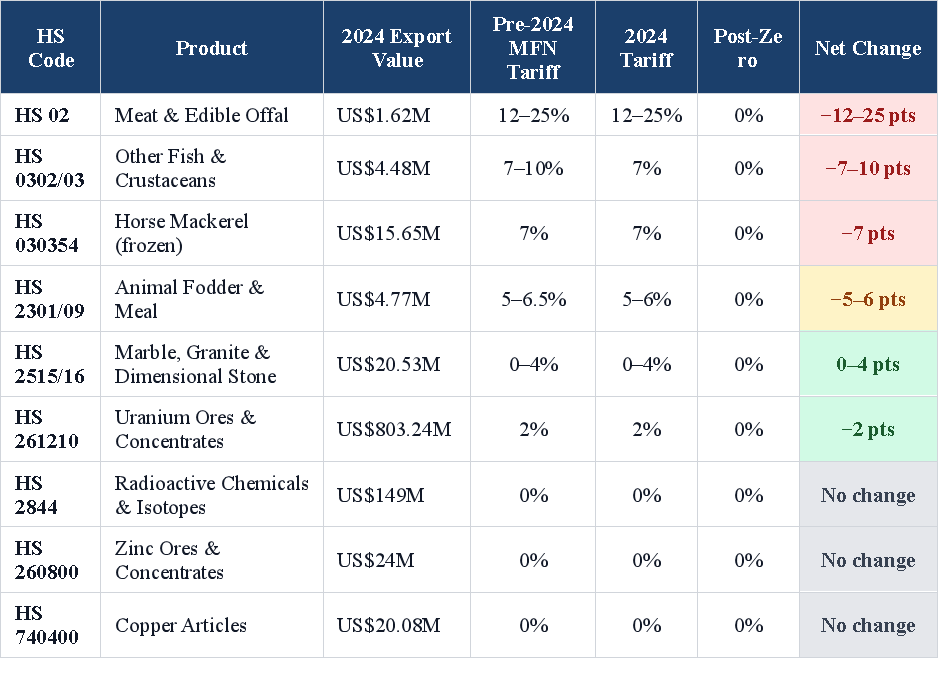
Namibia's export profile is heavily concentrated in uranium and nuclear-related radioactive materials — together representing approximately 70% of total exports to China. Uranium (HS 261210) attracted a pre-2024 MFN rate of approximately 2%, making the tariff saving modest. Fish and seafood (horse mackerel at 7%) and meat (12–25%) offer more meaningful percentage gains but on low absolute export values. Namibia's overall tariff benefit is structurally limited unless it diversifies into manufactured or agro-processed goods.
Botswana — Tariff Schedule
Total Exports to China (2024): US$769 million (+55.1% YoY)
Impact: MINIMAL
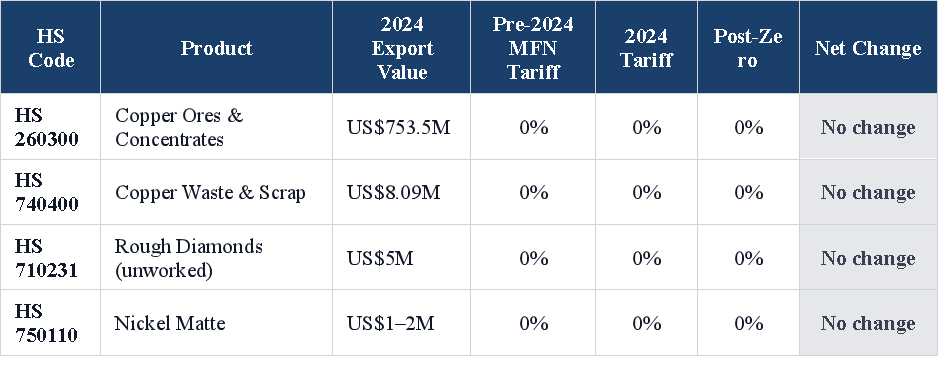
Despite strong export growth making China Botswana's second-largest export destination, the zero-tariff policy generates virtually no additional benefit. This is because all of its top exports (copper ore, copper scrap, rough diamonds, nickel products) already entered China at 0% MFN. The policy principle is illustrated clearly here: tariff liberalisation does not assist exporters who are already tariff-free. Future benefit would only materialise through export basket diversification into manufactured or agricultural goods.
Mauritius — Tariff Schedule (China-Mauritius FTA, 2021)
Total Exports to China (2024): US$19.36 million
Impact: MINIMAL
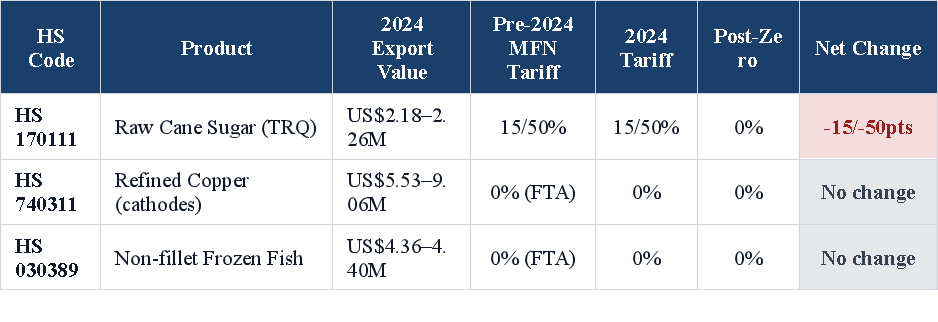
Mauritius signed a Free Trade Agreement with China in January 2021, granting early duty-free access for most product categories. As a result, the December 2024 zero-tariff expansion appears to offer limited additional benefit for the existing Mauritius-China trade relationship. The principal exception is raw sugar (HS 1701), which operated under a Tariff Rate Quota (TRQ) with a 15% in-quota and 50% out-of-quota rate, but the export value of raw sugar to China is relatively small (approximately US$2.2 million). Therefore, the overall impact remains limited.
Author | Leigh-Anne Richards
Editor | Lou Siqi; Zhao Han; Wang Yijie

Wechat丨CADFUND