Source:https://mp.weixin.qq.com/s/CMipUBWW8rPzv40tTbDtTQ
Introduction
China’s extension of zero-rated tariff access to African trade partners—initially granted to Least Developed Nations (LDNs) from 1 December 2024 and subsequently expanded to cover the majority of African countries with diplomatic relations with China—marks a significant structural recalibration of the Sino-African trade framework. This policy shift effectively removes tariff barriers across a broad range of product categories, transitioning the bilateral trade relationship from preferential access to near-universal duty-free treatment. As a result, the competitive landscape for African exports into China is being fundamentally reshaped, with implications that extend beyond trade flows to investment patterns, industrialisation pathways, and regional value chain development. This report provides a granular, data-driven assessment of the policy’s implications on eight Southern African Development Community (SADC) countries—Botswana, Lesotho, Madagascar, Mauritius, Mozambique, Namibia, South Africa, and Zimbabwe.
Country Overview:
2024 Export Profiles & Tariff Impact
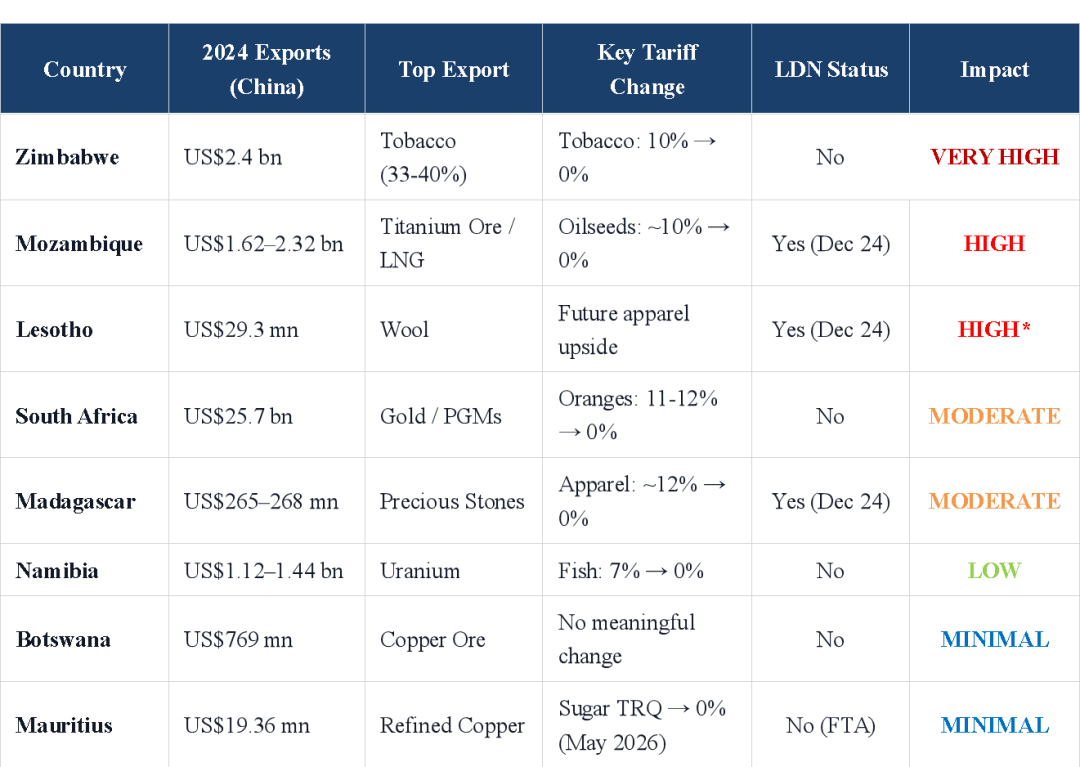
The table below summarizes the eight SADC countries covered in this report, their 2024 export value to China, and the headline tariff changes under the zero-rated policy.
* Lesotho's HIGH rating is conditional on manufacturing scale-up in apparel and footwear sectors currently under development.
Key Insights
Key Finding 1:
Diversified Export Baskets Secure the Greatest Incremental Benefits
An interesting discovery about the zero-tariff policy is that African commodity exporters are precisely the countries for whom tariff liberalization provides the least incremental benefit. China established its commodity import regime decades ago, setting MFN rates for ores, metals, and energy fuels at zero to ensure input supply for the manufacturing sector. By the time 2024 when the policy was announced, gold, platinum, copper ore, chromium, iron ore, uranium, coal, LNG, and titanium ore all already entered China duty-free.
The policy therefore primarily benefits African nations with diversified export baskets — where a share of goods face genuine tariff barriers. The inverse relationship between commodity dependence and tariff benefit can be stated simply:
Key Finding 2:
Not Just a Trade Concession, but an Investment Signal
China's zero-tariff policy is best understood not as a trade concession, but as an investment signal. By eliminating import duties on SADC goods, China has effectively reduced the cost of Southern African production for any enterprise — Chinese or otherwise — seeking to supply the Chinese market. For Chinese investors, this creates a materially different calculus: production or procurement in Southern Africa now competes on cost with domestic or ASEAN-sourced supply without a tariff penalty.
The optimal investor response to the zero-tariff regime is backward integration: establishing or acquiring production, processing, or sourcing operations in Southern Africa to supply Chinese end markets at zero duty. This model captures not just the tariff saving, but also the underlying cost advantage of Southern African inputs — land, labor, and raw materials.
Conclusions
China's zero-tariff policy is a significant trade liberalization measure. But unlocking its full economic impact requires Southern African governments and their trading partners to invest in the supply-side capacity, certification infrastructure, and logistics networks to convert tariff access into export volumes. For Chinese enterprises, the policy creates a first-mover advantage: those who establish production, sourcing, and logistics positions in Southern Africa now will secure preferential supply arrangements in sectors where demand is growing and import costs have structurally fallen.

Leigh-Anne Richards
Principle at CADFund Representative Office in South Africa, with 25+ years of cross-border investment experience in Africa and an MBA from the Gordon Institute of Business Science.
中非发展基金南非代表处
二级高级主管
拥有逾25年非洲跨境投资经验,并持有戈登商学院的MBA学位。
Author | Leigh-Anne Richards
Editor | Lou Siqi; Zhao Han; Wang Yijie

Wechat丨CADFUND